Swiss-trained, with fifteen years leading restaurants, hotels, events and cruise suites, most recently opening a 4,000-cover-a-week members-only restaurant with a 200-person team. I turn what the floor taught me into software managers actually use.
years in hospitality operations across the U.S., the Caribbean and Europe, on land and at sea
$90M
in operating budgets overseen across my roles, consulting clients and my own company
200
person unionized team led through 17 managers
4
software products designed and built
The work, in thirty seconds
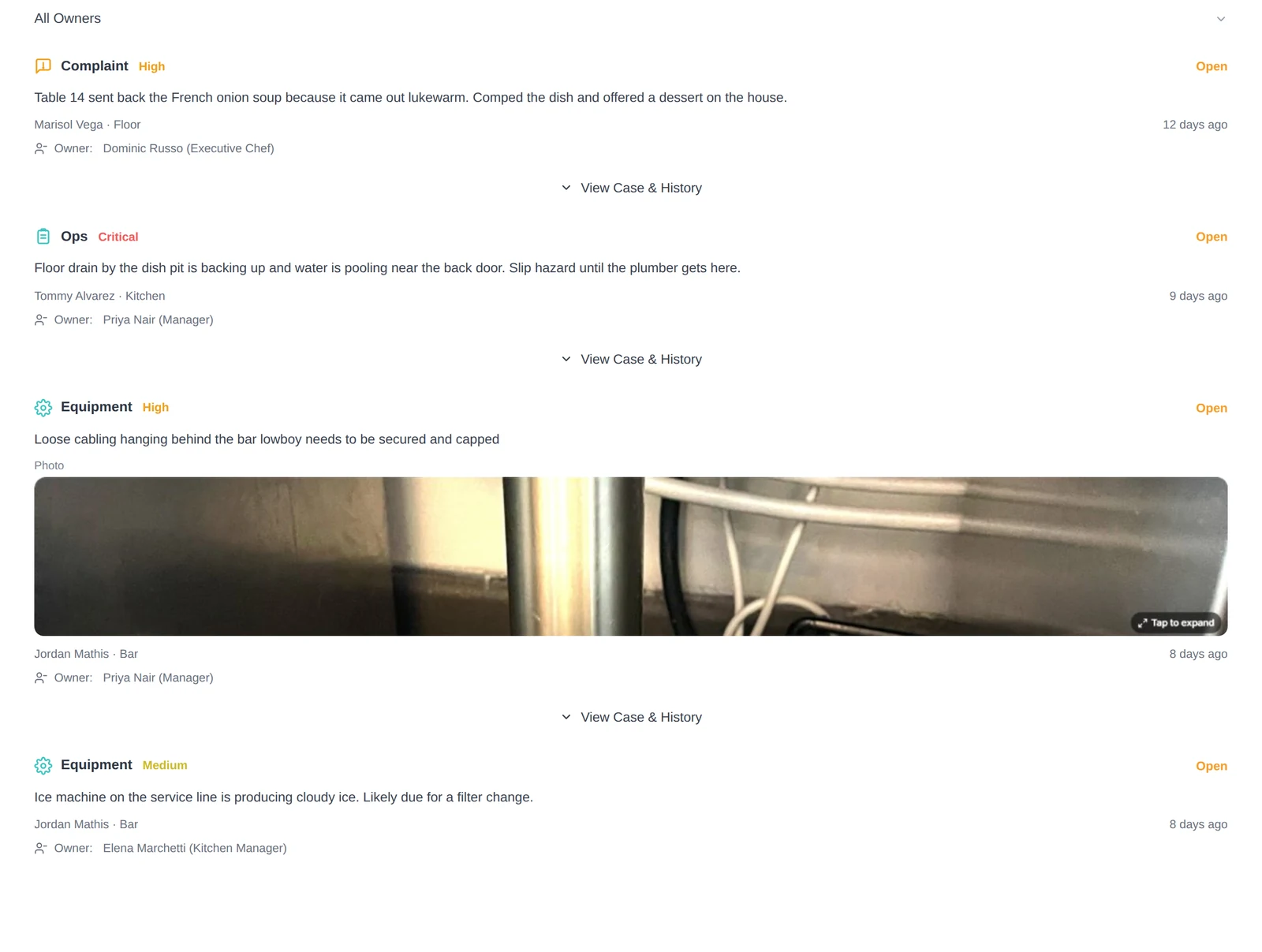
One shift note, followed all the way through.
This is ShiftLog, the platform I built from what my last opening taught me. Watch a single guest complaint become a tagged record, an owned follow-up, a trend and a written standard.
Hot-holding temperature3rd related log this week. Likely a gap in procedure.
Create SOP
What’s the standard for holding soups at the pass?
Shiftly
Hold at 135°F or above. Probe and log every two hours. If a reading drops below, reheat to 165°F once or discard.
Source · Kitchen SOP, Hot holding
A twenty-second note becomes structured data.Simulated · sample data
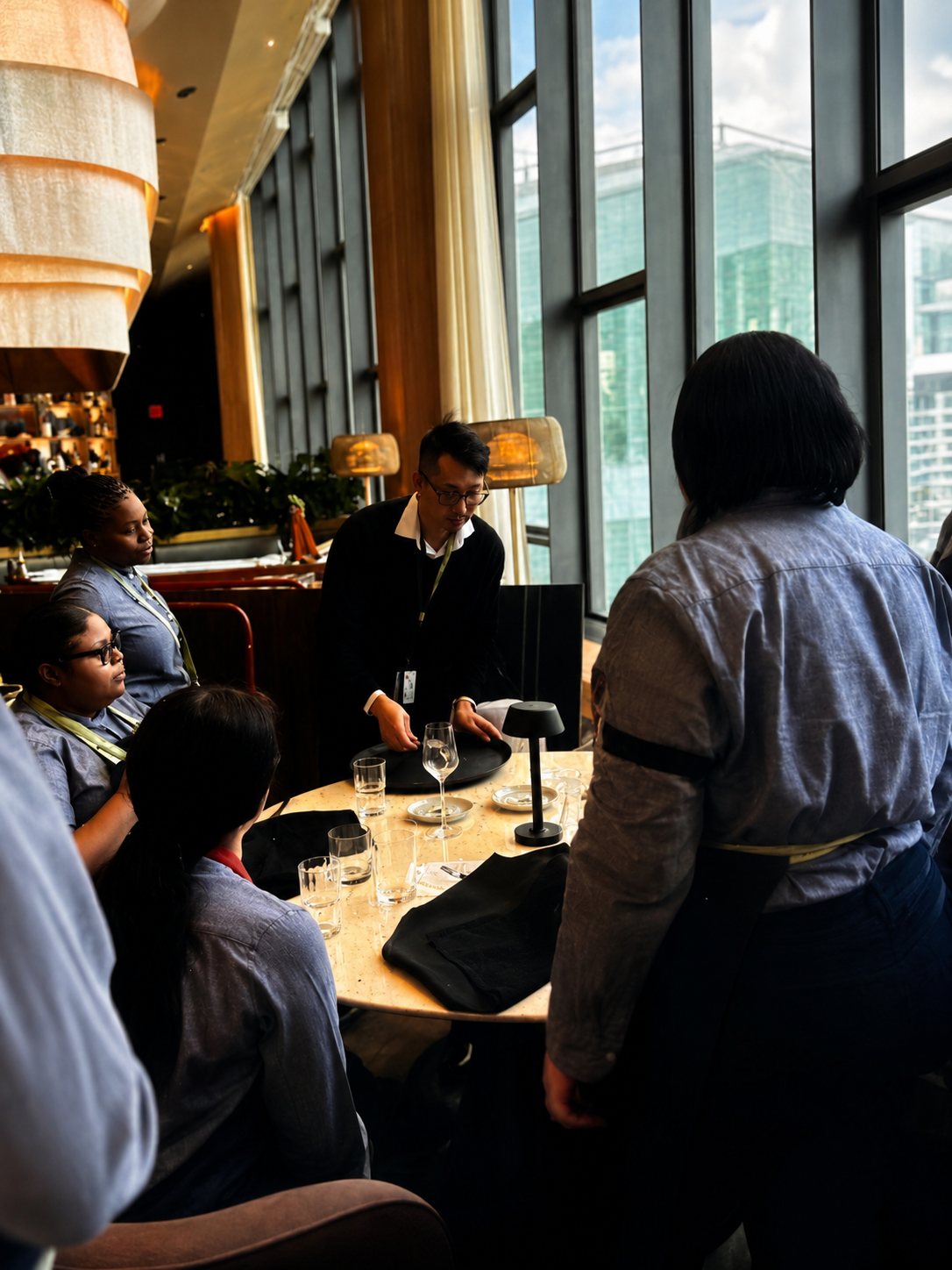
Pre-shift service training
The point of view
Good hospitality AI starts with someone who has closed a shift.
The data that matters in a restaurant is not in the POS. It is in a notebook, a group chat and a verbal handoff at 11 PM. I know where it lives because I spent fifteen years producing it.
Operator first
Opening GM, founder, consultant, VIP suite manager. I have owned the P&L, the union conversation and the Saturday night.
Quantify the qualitative
I turn shift notes and guest moments into scores leaders can act on, like the Derived Guest Satisfaction score I designed as a leading signal for NPS.
Build it, then make it stick
I ship the tool, write the SOP, train the managers and track the follow-through. Adoption is the deliverable.
The central idea
Quantify the qualitative.
Hospitality runs on feelings. A guest felt rushed. A shift felt off. A candidate felt right. I believe every one of those can be turned into a number a manager can act on, and that belief sits underneath everything I build.
What you hear on the floorWhat I measure insteadWhere it lives
“The guests seemed happy tonight.”
Derived Guest Satisfaction score
A 0 to 100 score built from the guest-impacting events logged on each shift, so the read arrives before the survey does.
ShiftLog
“We keep having this problem.”
Recurrence count
The third related log in a week raises a flag and proposes the procedure that is missing.
ShiftLog
“The team is on top of things.”
Follow-up aging
An issue still open after 24 hours needs attention. One with no update in 48 hours has stalled.
ShiftLog
“The kitchen felt slow.”
Ticket time, average and slowest tenth
Under 15 minutes on average and under 25 for the slowest one in ten, because the average hides the table that waited.
Metrics Handbook
“Service is solid.”
Service Health Index
Ticket time, line-check pass rate, comps and voids, and manager hours on the floor, standardized and combined into one score.
Metrics Handbook
“The menu works.”
Menu Heat Index
How fast an item sells, multiplied by its margin and by what guests say about it.
Metrics Handbook
“The reviews are fine.”
Rating, response time, complaint rate
4.5 or higher, every review answered within two hours, and complaints counted against covers served.
Metrics Handbook
“They feel like a strong hire.”
Structured interview score
Thirteen dimensions, eleven scored from behavioral questions and two from observation, rolled into one recommendation.
Hiring guides
Patterns become measurable. Decisions become defensible.
Case study · 2025–26
Opening a members-only restaurant, and building the operating system to run it.
Capital One Landing, New York Flik International with José Andrés Group Opening General Manager
The situation
A members-only restaurant opening from zero, its menu curated by Michelin-starred chef José Andrés. 4,000+ covers a week, a 200-person unionized workforce, ten front-of-house and seven back-of-house managers, and a guest standard with no room for an off night.
Shift information lived where it always does. Issues were raised, then lost between handoffs.
What I built
25+ standard operating procedures, written and enforced
Manager dashboards and task tracking, so every assigned follow-up was dated, owned and logged
An AI policy assistant that answers managers’ questions from the SOPs, instantly
A Derived Guest Satisfaction score that reads guest experience from operational events before the survey arrives
What changed
Labor and food cost came down inside six weeks while the guest score held. Managers stopped asking “who has this?” because the answer was on the screen.
Wednesday revenue up 250% in two weeks, without a discount.
A restaurant owner’s Wednesdays were dead and the few guests were ordering beer. I read it as a confidence problem, not a price problem. Instead of another promotion, we ran a weekly ten-minute wine lesson with three featured bottles. Guests came for it, brought friends and moved from glasses to bottles.
Staff log incidents, complaints, wins and recoveries in seconds. Managers work a live feed, assign follow-ups and close them with a documented resolution. Leadership gets reports, scorecards and scheduled email summaries across every location.
Where the AI is
“Ask Shiftly” answers policy questions from the operator’s own SOPs with citations. Pattern detection suggests new SOPs. Report insights are generated from the period’s logs. Uploaded SOP documents are parsed, chunked and made searchable.
What I did
Founder. Product design, data model, role and permission hierarchy, billing, and the build itself. I also wrote the user guide, manager training guide and operational playbook that ship with it.
interface sketch
Labor Day · from what’s in the walk-in
Smoked Brisket Melt
Inventory fit 92%Food cost 27%$16
In build · pre-launch
Kalo Mas
Specials made today.
AI that turns the ingredients a restaurant already stocks into five costed, kitchen-ready specials. Pick an occasion or a surplus to use up; get inventory fit, food cost, prep instructions and a printable guest asset. Menus upload as PDFs and the ingredients are extracted automatically.
Built for a family diner whose manager has no tech experience. Every screen has one obvious action.
interface sketch
Crew ABoundaryStakeout
Crew BTopo survey
Crew CAs-builtLayout
First phases shipped · client project
GridMark
Dispatch for crews in the field.
A field-operations and dispatch platform for a land-surveying firm, replacing a legacy fleet-tracking workflow. Per-crew scheduling board with map view, project geocoding, invite-based onboarding and role-scoped access for owners, project managers and crews. Installs on a phone as a PWA.
Same method, different industry: the operating problem is always who is doing what, where, by when.
A local wellness marketplace. Members discover events from many hosts, buy a ticket, get scanned in at the door, and each verified check-in stamps a personal wellness passport. Hosts get a profile, event tools, a small shop and a private dashboard.
The test: does a passport make people book again, and book with a different host?
How these get builtAI-native development with Lovable and Claude Code React and TypeScript Supabase Postgres with row-level security Edge functions Stripe billing LLM features for retrieval, extraction and generation
Consulting toolkit
The playbooks behind the software.
The frameworks and templates I use with operators, drawn from seven years of independent consulting and from my own floors.
Restaurant Metrics Handbook
Ten manuals, each paired with a working tracker, covering the signals that predict a restaurant’s performance.
Guest sentiment & reputation
Social & PR buzz
Digital & SEO
Operations & service
Menu & product
Pricing & promotions
Customer loyalty
External & contextual
Financial health
Power combinations
SOP system
Discovery questionnaires for kitchen and floor, templates, and worked examples that take a procedure from someone’s head to a document a new hire can follow.
Guest Experience Playbook
Service standards, a staff training checklist and the recovery language that goes with them.
Discovery & engagement kit
Discovery-call questionnaire, proposal template and services agreements, so an engagement starts with scope, not guesswork.
Hiring guides
Structured interview guides for floor managers and career-fair screening.
Signature framework
T.A.C.T.I.C.A.L. service recovery
The eight steps every team member follows when something goes wrong, built around four words: I’m on your side.
T
Take a pause and assess
One or two seconds to breathe, clear your face and find a calm tone.
A
Acknowledge the emotion
The feeling before the issue. “I get that, and I would feel the same way.”
C
Communicate alignment
“I’m on your side, and I’m here to help you.”
T
Tactical listening
Hear the real need behind the complaint, and let silence do some of the work.
I
Identify the core problem
Say it back in one calm line, so the guest knows they were understood.
C
Create guided options
Never say no. “It’s difficult, but I’ll try. If not, how about…?”
A
Act with empowerment
Fix it now, without going to find permission. Speed builds trust.
L
Leave a lasting impression
Check back before they leave. Add a handwritten note if it fits.
How an engagement runs
Walk the floor
Work a service, read the logs, sit in pre-shift. Find where information dies.
Measure what matters
Pick the few numbers that move the P&L and the guest score, and make them visible.
Build the smallest tool
A prototype in days, in the hands of the manager who will use it. AI where it removes work, nowhere else.
Make it stick
SOPs, training and an owner for every follow-up, until the habit holds without me.
The open book
Nothing here is a secret.
I don’t have anything to hide. Hospitality matters wherever people deal with people: at home, in business, in companies that have nothing to do with hotels. If more of us practiced it, everything would run better. So here is what fifteen years taught me, one lesson at a time.
Lesson I
Put on the smile
The first few seconds set the terms for everything after.
When I supervised my school’s fine dining restaurant, I briefed the team the same way before service: put on your hospitality smile.
You don’t have to feel it first. There is research suggesting that even a smile you choose to put on lifts your own mood, and it is simply more welcoming to walk toward. It starts things on a good foot.
The same goes for the rest of those first seconds: your posture, your tone, a good handshake, and a sentence like “I’ve heard a lot of good things about you.” Start a relationship well and the impression lasts.
Lesson II
Say their name
Recognition is the first thing you can give someone, and it costs nothing.
A friend of mine, Jay, taught me this in a casino. Every server who came by, whatever they had done, he thanked by name. It made an impression every single time. I have done it ever since, and I noticed something else: people started remembering my name too.
As a Royal Genie I looked after the guests who paid the most to be on the ship, and I never brought them anywhere unannounced. Before we walked in, the head of department or the floor supervisor already knew who was coming. The first thing my guests heard was “Welcome,” followed by their name.
It pleased them every time. The attention to detail is the whole thing.
Lesson III
Open with something small
A small compliment gives two strangers something to talk about.
When I owned my restaurant, I asked my servers to start every table by noticing one thing. Nice shoes. I love your hair. That ring is pretty cool. It hands the guest something to talk about, and often it turns out to be something you both like.
On the ship I did the same with jokes, usually stupid ones. A guest would say, “I did that once, but it was a long time ago, maybe fifteen years.” I would say, “Oh, so when you were eighteen.” They were clearly around fifty.
The small jokes are the ones that leave a mark. Everyone loves a sense of humor.
Lesson IV
Listen, then say nothing
When someone is upset, silence does more than any apology.
The first time I got this wrong, I was working in my dad’s restaurant. I was carrying a large tray of water and spilled all of it over a guest. I was embarrassed. I could not apologize enough, and nothing I said helped.
Years later, on the ship, a man screamed at me because too few of the crew spoke his language. There was nothing reasonable in it. This time I let him finish. I left a long, deliberate pause. Then I told him his feelings were understood, and I used my four magic words: I’m on your side.
On a good day, listening works the same way. I listen for what people like and what they don’t, because that is where the small gift comes from, or the note with the inside joke.
Lesson V
Refine the sentence
You don’t avoid the hard conversation, and you don’t make it abrasive.
At butler school, one of the lessons that stayed with me was how to word things. Sometimes you have to tell a guest that something costs money, without making them feel you are taking advantage, and without implying they didn’t already know. My teacher’s phrase was that it is “of a chargeable nature.”
I don’t talk like that, so I don’t say that. I say, “I’ll also find out what costs are associated with it.” The same information, in my own voice.
The phrase isn’t the point. With the right language you can steer almost any difficult conversation, and the care you took is what people remember.
Lesson VI
Never say no
Let people make the decision themselves, and they never feel refused.
My guests on the ship paid between $15,000 and $70,000 for a week. They wanted to feel like kings, and who was I to say otherwise. So I never told them no. I told them I would look into it, even when I was sure it couldn’t be done. The reality is that most things can be bought.
One guest wanted a very expensive bottle that wasn’t on board. I found one in Miami. We were in the middle of the sea, on our way to the Bahamas. Rather than call it impossible, I priced it: the helicopter, customs, everything it would take to get that bottle to the ship. It came to around $30,000.
I knew they would decline. But they were the one who decided. They didn’t feel rejected, and they knew I had tried.
Lesson VII
Give them a game
People love a game they can win. Let them, because you win too.
I’m Chinese, and I was born and raised in Jamaica. The accent does not match the face. I turned that into a game: something on me if you can guess my nationality before the end of your stay.
I played it at the front desk of a luxury hotel in North Carolina. When someone got it right, I honored the bet with a comped drink or an amenity.
It cost me very little. They remembered me, and they tipped better.
Lesson VIII
Know a little about everywhere
Ask people where they are from, then let them talk.
The fastest way I know to bond with a stranger is to know something about their home. I would talk to Polish guests about pierogi, Russian guests about their Easter traditions, Swedish guests about the stinky canned fish they sell.
Then I ask my favorite questions. What’s it like over there? Do you miss it? Did you love it growing up?
People will talk about where they are from for hours. Somewhere in those hours is everything you need to know about what they like and what they don’t. Culture, food and travel never fail.
Lesson IX
Watch the feet
Sometimes the kindest service is ending the conversation.
Even when you are doing everything right, people have bad days. They are tired, and they keep talking to you out of courtesy.
I took one habit from the book What Every Body Is Saying and I use it all the time: I watch where the toes point. If I am in a long conversation and their feet have slowly turned away from me, I take the hint before they have to give one. “I can imagine you might be tired.” Or, “Anyway, let me get out of your way.”
They appreciate it.
Lesson X
Find what they didn’t ask for
The best hospitality happens in the space between what people ask for and what they need.
On the ship, a couple’s friends pulled me aside during an afternoon cocktail hour. The two of them had been together fifteen years, they said, and had not had a proper date night, just the two of them, in longer than anyone could remember. Kids, work, life.
The couple had not asked me for anything. I spent the next two hours quietly learning from their friends what they loved, and what they would choose if nobody was watching.
By evening their suite was set. Candlelight. A menu built from what I had learned: not what they ought to eat, but what they actually wanted. No crew hovering. I appeared when I was needed and vanished when I wasn’t.
When they saw it, her eyes filled and he reached for her hand. When I came back to clear the plates, they were present with each other in a way they had not been all week. That dinner was not on any menu.
Lesson XI
Sell the feeling, not the discount
Revenue hides in the gap between what people order and what they want to feel.
A restaurant owner came to me with a problem. Wednesdays were dead, and the guests who did come in, mostly women in their twenties and early thirties, ordered beer and vodka sodas. He had tried happy hours and two-for-ones. Nothing moved.
I had watched the same thing for years in fine dining and on the ship. Guests would hover over the wine list, hesitate, and order something safe. They didn’t dislike wine. They didn’t feel confident ordering it.
So we built Wine Wednesday, and it was not a discount night. Three wines each week: one old world, one new world, one wild card. Ten minutes from me at the start of the night on how to say the names, why each one tasted the way it did and what to eat with it. Then tastings at the bar, no pressure.
Within two weeks, Wednesday revenue was up 250%. Groups came for it, brought friends and started ordering bottles instead of glasses.
Lesson XII
Forgetting is the real failure
Operations rarely fail because something went wrong. They fail because it was forgotten.
Things go wrong on every shift. A cooler runs warm. A table waits too long. Someone calls out. None of that is what sinks an operation.
What sinks it is the handoff at the door, the “I thought you had it,” the issue everyone assumed was resolved. Problems get buried under the pace of service, and they come back bigger.
So I ask three things of any operation I run. Every event is captured. Every issue has one person responsible for it. Every case is closed with proof that it was dealt with. Visibility, ownership, resolution.
Lesson XIII
Write for the manager who wasn’t there
A note that only makes sense to you is not a record.
“Fridge issue in kitchen” tells the next manager nothing. Compare it with this: walk-in cooler reading 48°F at the start of the PM shift; maintenance called; temperature-sensitive items moved to the backup unit; a health risk if it isn’t fixed before tomorrow’s service.
The second one answers four questions. What happened? Where? Who was involved? What was the impact? Anyone who reads it can act, including someone who was off that day.
I ask the team to write it before they move on to the next thing. A note reconstructed three hours later has lost the details that made it useful.
Lesson XIV
“Handled” is not an ending
The task getting done is not the same as the problem being solved.
The weakest word in operations is “handled.” It closes the conversation and tells you nothing.
A real ending says what was done, who did it and how you know it worked. Maintenance replaced the thermostat. The unit is holding at 38°F this morning. The kitchen team confirmed it. Now it can be closed.
That last note matters more than any other. If the same thing happens six months from now, the next manager will know what was tried and whether it held. And waiting is no excuse for silence. “Parts arrive Thursday, technician booked Friday” is a healthy case. Three days of nothing is a forgotten one.
Lesson XV
Hand over in writing
A handoff at the door is a conversation, and conversations are forgotten.
I use one test at the end of a shift. Could the incoming manager sit down, read for three minutes and know exactly where things stand, without me in the room?
If not, the handoff isn’t finished. What I say on my way out will be gone by the first rush. What I wrote will still be there next week, for the next manager and the one after.
It takes five to ten minutes at each end of a shift. Before service: what is open, what is overdue, what has no owner. After: everything major is written down, every open issue has a current note, and nothing lives only in someone’s head.
Lesson XVI
Give the floor the authority
Managers are there to support, not to stand at the gate.
A guest with a problem should not have to wait while someone finds a manager. By the time permission arrives, the moment to fix it has passed.
So in my service playbook, every team member has the authority to act on the spot: replace a wrong or late dish, offer a drink, move the table, send a dessert, write a note by hand. No approval needed.
It only works if people know exactly what they are allowed to do, and know I will back the decision they made.
Lesson XVII
Three times is a pattern
When the same thing happens three times, stop asking who and start asking what.
The first time something goes wrong, it is an incident. When it shows up three times, across different shifts and different people, it is no longer anyone’s mistake. It is a gap in the process.
The wrong question is “why did this happen again?” The useful one is “what do we need to change so it stops happening?” Usually the answer is a procedure nobody has written down yet.
I wrote more than twenty-five procedures for my last opening. A procedure earns its place when it answers a problem that kept coming back.
Lesson XVIII
Take the blame out of the record
Writing something down is not an admission of fault. It is professional communication.
If people think that reporting a problem will get them in trouble, they stop reporting. You don’t end up with fewer problems. You end up blind.
Two things fix that. First, record the good as well as the bad: the compliment, the recovery, the server who handled a hard table well. A record that only holds failures feels like a file being built against you.
Second, act on what people tell you. When someone flags a broken door and sees it fixed by Thursday, they flag the next thing. When their note disappears into a void, they stop. Follow-through is what builds the habit.
Lesson XIX
If everything is critical, nothing is
Urgency only means something when you ration it.
Every operation has someone who marks everything urgent. After a week, nobody can tell what actually needs attention tonight.
I keep four levels and ask people to use them honestly. Low is minor or already dealt with. Medium needs attention soon. High is hurting service, safety or the guest right now. Critical is a genuine emergency.
The other half is noticing small things early. Equipment running differently than usual. A stock level that looks thin. A shift that is always stretched. None of them is a problem yet, which is exactly when they are cheapest to fix. The best operations catch it before it reaches the guest.
Lesson XX
Build the check into the procedure
A good procedure tells you it has gone wrong before anyone else does.
When I write a closing procedure for cash, the count is only part of it. The step that matters is the control: the net cash on every register’s report, added together, has to equal the net cash on the system report. If it doesn’t, you stop there.
Then the procedure says what to do about a gap. A small variance: recount once and note the reason. A larger one: recount twice, document it and tell the manager on duty.
It ends with a short checklist someone can follow at midnight when they are tired. I test every procedure the same way. Could a new hire run it alone, and would it catch its own mistake?
Lesson XXI
Measure what happens before the review
By the time it shows up in a review, it has already happened to a guest.
Reviews and surveys tell you about last week. The floor tells you about tonight. Slow tickets, dishes running out, complaints, recoveries: operational problems show up there first, before they reach your ratings or your revenue.
So I track the early numbers. Not only the average ticket time but the slowest one in ten. How many items ran out during service. How many hours a manager actually spent on the floor.
At my last opening I went a step further and built a score from the shift record itself, a read on guest satisfaction designed to move before the survey does. Then I bring it to the table. Replace “how did the week go?” with the record, and the conversation goes from opinion to specifics.
1 of 21
Look after the guest, write things down, and fix what keeps coming back. Most of it is that simple.
Experience
Fifteen years, on land and at sea, every seat in the house.
Swiss-trained in hotel management. I have worked in the United States, Jamaica and Switzerland, and on ships sailing the Caribbean and Bermuda, with a month on Asian routes out of Shanghai.
2026 – present
Founder, ShiftLog
Series S Management · New York
Created a hospitality operations platform that turns shift notes, guest feedback and service issues into structured insight and management follow-up.
2025 – 2026
Opening General Manager, Capital One Landing
Flik International · José Andrés Group · New York
Opened and led a members-only restaurant curated by José Andrés, with full P&L ownership of a $15M+ annual operating budget. 200-person unionized team, 4,000+ covers weekly, 90+ NPS. Cut labor 25% and food cost 15% within six weeks.
2019 – 2025
Founder & Managing Director, PSA Hospitality Group
Rise & Grind: Kitchen & Coffee Bar · Long Island / Kingston, Jamaica
Built and operated a café-bar concept. Grew EBITDA roughly 30% and beverages to 35% of sales, led a $500K renovation, and developed the brand standards, operating manuals and franchise system.
2016 – 2019
Royal Genie, Allure of the Seas
Royal Caribbean International
Personal host for premium-suite guests with bookings valued up to $240K, aligning dining, entertainment, housekeeping and security around each guest. Sailed the Caribbean and Bermuda, plus a month on Asian itineraries calling at Shanghai, Singapore, Malaysia, Thailand and Hong Kong.
2012 – 2019
Principal Consultant
Independent Hospitality Consulting · Jamaica / New York
Advised restaurant and bar owners on service standards, commercial performance and restructuring. Recruited general managers and bar directors; built financial models and investor presentations.
2009 – 2013
Co-Founder & Managing Director, The Pardii People
Kingston, Jamaica
Produced events for 800 to 1,600+ guests with 40+ contractors, and negotiated sponsorships with Appleton, Worthy Park and Hpnotiq.
Earlier: Old Edwards Inn & Spa, North Carolina (2015) · Swiss Education Group, Switzerland (2014)
Contact
If your clients run hospitality and you’re bringing them AI, I’d like to help.
Open to consulting engagements and to roles in AI, operations and hospitality practices.